The Record-Driven BIA Appeal Method
Most appellate resources teach you how to write a brief. This series teaches you how to read a record.
Note from the humble writer:
Years ago, during a Webex merits hearing, my mentor walked into the room, looked at my screen, and wrote on a sticky note:
YOU ARE LOSING. MAKE SURE TO GET EVERYTHING IN THE RECORD.
We weren't even close to the end of the hearing.
I trusted her judgment. From that moment on, I made sure not only that every one of my arguments made it into the record, but also that the Immigration Judge and DHS committed theirs to the record.
She was right. I lost before the Immigration Judge, but won before the Board of Immigration Appeals, won again before the next Immigration Judge, and today that client is living somewhere safe with her partner.
It's been six years since then. I'm now two years into my solo practice, without anyone looking over my shoulder to catch my mistakes. We don't have the luxury of making them anymore.
Most appellate resources teach you how to write a brief. This series teaches you how to read a record.
Every Teaching Case reconstructs a real appeal, decision by decision, from the certified record to the final filed brief, including the drafting decisions, abandoned arguments, and editorial reasoning in between. Each one teaches a single mental model that you can carry into your next appeal.
If this entire series isn't in your budget right now, that's completely okay. You don't have to buy or learn everything at once.Each Teaching Case is available individually because every appeal presents different problems. Start with the lesson that matches the case in front of you today, or build the complete Record-Driven BIA Appeal Method over time

Years ago, during a Webex merits hearing, my mentor walked into the room, looked at my screen, and wrote on a sticky note:
YOU ARE LOSING. MAKE SURE TO GET EVERYTHING IN THE RECORD.
We weren't even close to the end of the hearing.
I trusted her judgment. From that moment on, I made sure not only that every one of my arguments made it into the record, but that the Immigration Judge and DHS committed theirs to the record too.
She was right.
I lost before the Immigration Judge, but won before the Board of Immigration Appeals, won again before the next Immigration Judge, and today that client is living somewhere safe with her partner.
It's been six years since then. I'm now two years into my solo practice, without anyone looking over my shoulder to catch my mistakes. We don't have the luxury of making them anymore.
Over the past year alone, I've had to file more than fifty appellate briefs. I had to adapt quickly to the changing approaches of the Board and the circuit courts, often in real time while trying to protect my clients.
Somewhere along the way, I realized my method of writing had changed.
This series grew out of months of notes, analysis, revisions, frustration, and elimination of ideas that didn't survive the record, not because I expect to win every appeal, but because I want every client's brief to be the strongest brief I know how to write.
Most appellate resources teach you how to write a brief.
This series teaches you how to read a record.
Every Teaching Case reconstructs a real appeal, decision by decision, from the certified record to the final filed brief, including the drafting decisions, abandoned arguments, and editorial reasoning in between. Each one teaches a single mental model that you can carry into your next appeal.
I also tried to make it fun by giving each type of appeal a theme, using my favorite singers and lyrics! If you're a Swiftie, you'll probably catch a few references. If you're not, don't worry, the appellate lessons still work.
If this entire series isn't in your budget right now, that's completely okay.
You don't have to buy or learn everything at once.
Each Teaching Case is available individually because every appeal presents different problems. Start with the lesson that matches the case in front of you today, or build the complete Record-Driven BIA Appeal Method over time
Over the past year alone, I've had to file more than fifty appellate briefs. I had to adapt quickly to the changing approaches of the Board and the circuit courts, often in real time while trying to protect my clients.
Somewhere along the way, I realized my method of writing had changed.
This series grew out of months of notes, analysis, revisions, frustration, and elimination of ideas that didn't survive the record, not because I expect to win every appeal, but because I want every client's brief to be the strongest brief I know how to write.
I also tried to make it fun by giving each type of appeal a theme, using my favorite singers and lyrics! If you're a Swiftie, you'll probably catch a few references. If you're not, don't worry, the appellate lessons still work.
The Complete Collection · $399
The Method + all six Teaching Case Files + every future release, added to your library automatically. Purchased individually: $693.
The Complete Collection includes every future Teaching Case , each new Case File is added to your library automatically at no additional cost, as its appeal concludes and its protective review clears.
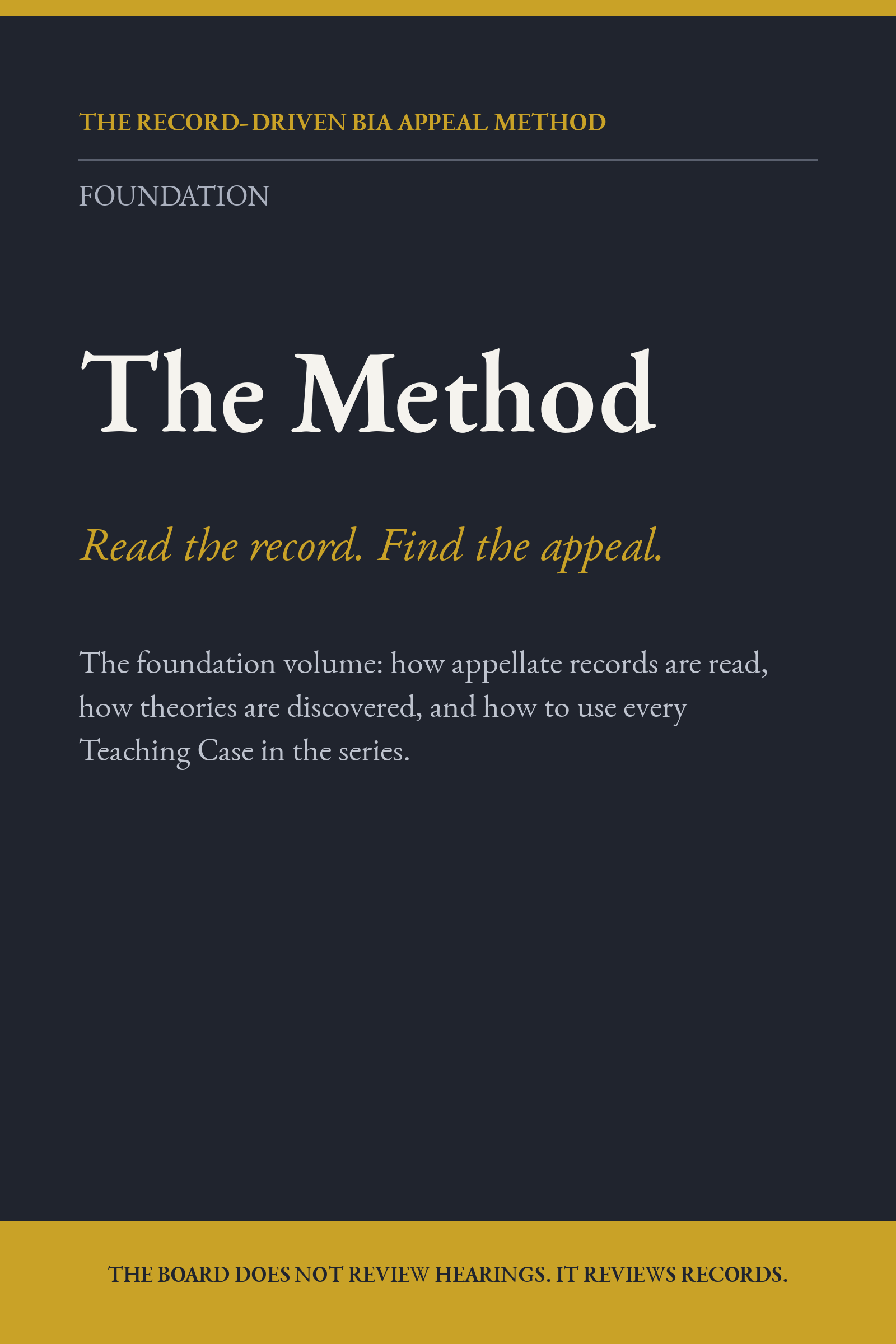
The Method is the textbook of the Record-Driven BIA Appeal Series:
It explains what record-driven advocacy is, why the Board reviews records rather than holds hearings, how appellate theories are discovered inside a record, and how to use every Teaching Case. It also includes the series roadmap and the practice instruments used throughout the curriculum.
You don't have to learn or buy everything at once.
Read the textbook first, then apply the method to your own writing, in your own style.
This is a textbook for practicing attorneys, not a formula to copy.
There is rarely only one right way to brief an appeal. My goal is simply to show you another way to read the record and build appellate arguments.
If you want to see the method applied in real litigation, the six Teaching Cases are available individually.
Each one reconstructs a different appeal and teaches a different mental model for approaching appellate records.
Start with the lesson that best matches the case in front of you today, or build the complete Record-Driven Method over time.
-
Immigration attorneys who handle — or want to handle — BIA appeals: solo practitioners, small firms, nonprofit attorneys, and experienced lawyers facing an unusual record. If you write briefs from records, this method is for you.
-
One real appeal, reconstructed decision by decision. Each Case File contains the Teaching Case manuscript, the annotated redacted filed briefs, the Editorial Decisions reference, the Lessons volume, a one-page Cheat Sheet, and the Teaching Deck.
-
Yes. Every volume documents a real appellate reconstruction — the real record, the real filed briefs, and the real evolution of the reasoning in between, dead ends included.
-
Aggressively. Clients appear only by teaching-case initials; no names, no A-numbers, no countries (regions only), no detention facilities, and dates appear as month and year only. Judges, courts, and all legal authority are real — the record analysis is what you are buying.
-
No. Every Teaching Case stands on its own and teaches one complete mental model. Start with the lesson that matches the problem in your appeal today.
-
If you want the full curriculum: The Method, then Movement I (The Archer, Mastermind, Hoax), then Movement II (Domino, Blank Space, Because I Said So). Each volume also tells you where to go next.
-
The Complete Collection includes every future Teaching Case at no additional cost — new volumes are added to your library automatically as their appeals conclude and their protective reviews clear.
-
Searchable, bookmarked PDFs designed for reading and for the desk, plus the Teaching Deck as a presentation file. The Cheat Sheet is built to be printed.
-
No. This is legal-education material about appellate method. It is not legal advice, does not create an attorney-client relationship, and is not accredited CLE.
Choose the Lesson You Need Today
You don’t have to learn everything at once. The Teaching Cases are available individually because every appeal presents different challenges. Start with the lesson that’s most relevant to the case in front of you today, or build the complete Record-Driven Method over time.
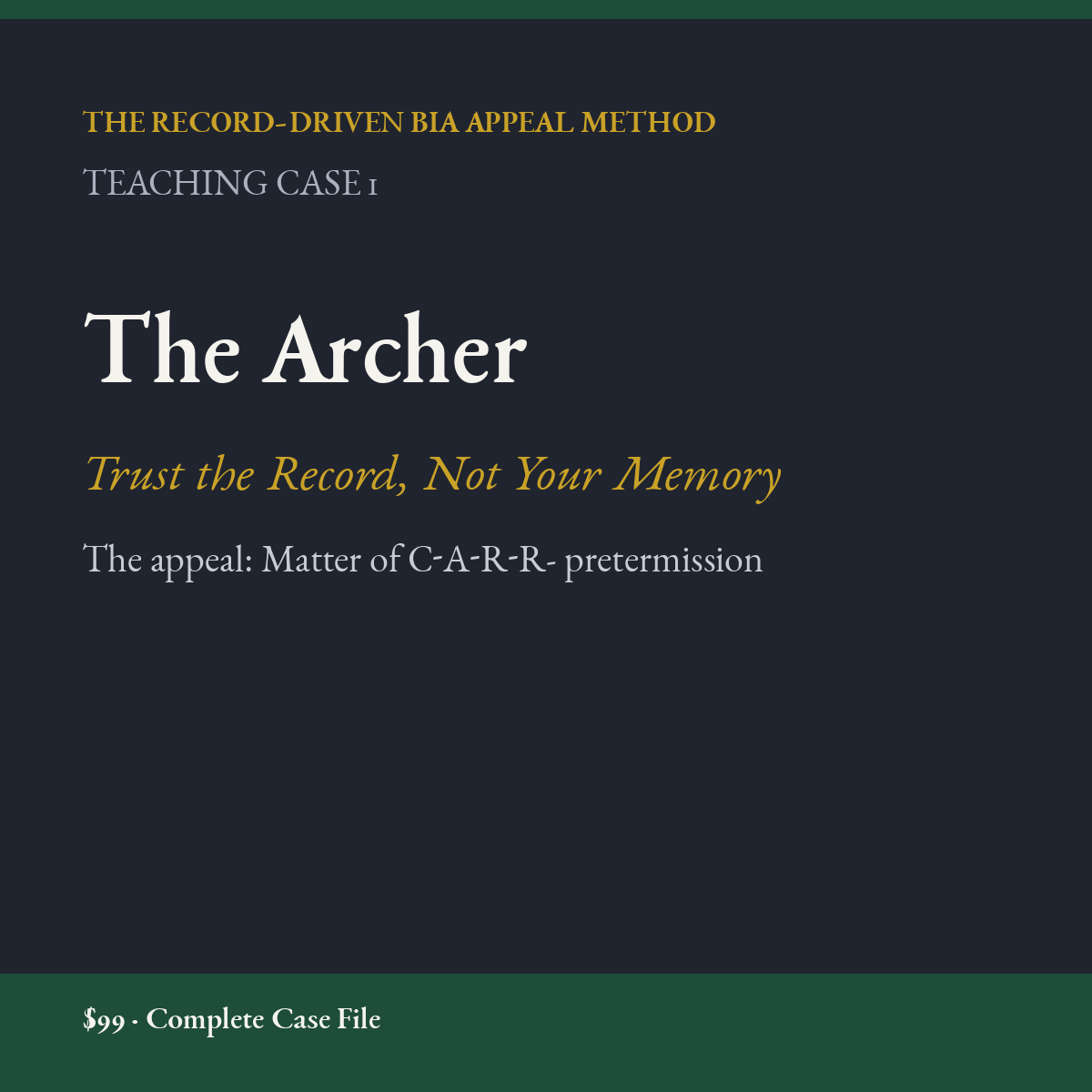
The appeal: Matter of C-A-R-R- pretermission.
Mental model: Trust the record, not your memory of the hearing.
You’ll learn:
✓ Audit your own filed language against the certified transcript, before your opponent does.
✓ Convert a bias narrative into a structural argument the Board cannot shrug off.
✓ Run vitality checks that catch the precedent that died while you weren’t looking.
You’ll benefit most if your appeal involves:
• A hearing that felt hostile and a record that must now prove it.
• A lead precedent that may have died since you last checked.
What’s inside
✓ Teaching Case (the full reconstruction)
✓ Annotated Filed Briefs
✓ Editorial Decisions
✓ Lessons from the case
✓ One-page Cheat Sheet
✓ Teaching Deck
1. The Archer — Teaching Case 1 · $99
The appeal: Matter of C-A-R-R- pretermission.
Mental model: Trust the record, not your memory of the hearing.
You’ll learn
✓ Audit your own filed language against the certified transcript — before your opponent does.
✓ Convert a bias narrative into a structural argument the Board cannot shrug off.
✓ Run vitality checks that catch the precedent that died while you weren’t looking.
You’ll benefit most if your appeal involves
• A first brief filed before the transcript existed.
• Quotations or characterizations you cannot pin to a certified page.
• A hearing that felt hostile — and a record that must now prove it.
• A lead precedent that may have died since you last checked.
What’s inside: Teaching Case (the full reconstruction) · Annotated Filed Briefs · Editorial Decisions · Lessons from the case · One-page Cheat Sheet · Teaching Deck
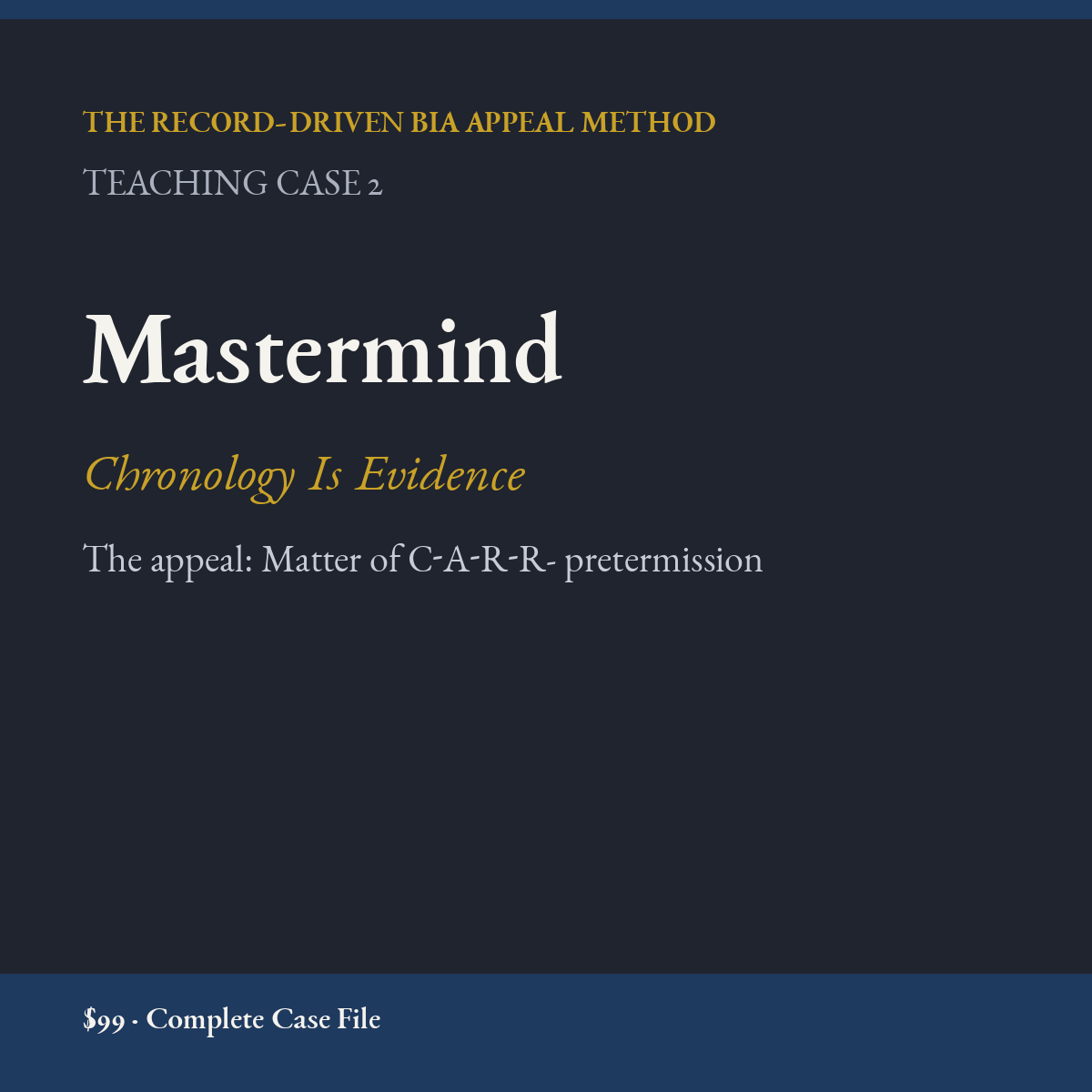
The appeal: Matter of C-A-R-R- pretermission.
Mental model: Chronology is evidence.
You’ll learn:
✓ Build timelines that become appellate arguments, sequence as evidence.
✓ Mark the two dates that expose a defect: first named, and last chance to cure.
✓ Enforce a judge’s own orders — the argument courts cannot shrug at.
You’ll benefit most if your appeal involves:
• A pretermission, abandonment, or “incomplete application” finding.
• A defect named for the first time after the chance to cure it had closed.
• Multiple hearings and a complicated procedural sequence.
• A judge’s remark or history imported from outside the record.
What’s inside
✓ Teaching Case (the full reconstruction)
✓ Annotated Filed Briefs
✓ Editorial Decisions
✓ Lessons from the case
✓ One-page Cheat Sheet
✓ Teaching Deck
2. Mastermind — Teaching Case 2 · $99
The appeal: Matter of C-A-R-R- pretermission.
Mental model: Chronology is evidence.
You’ll learn
✓ Build timelines that become appellate arguments — sequence as evidence.
✓ Mark the two dates that expose a defect: first named, and last chance to cure.
✓ Enforce a judge’s own orders — the argument courts cannot shrug at.
You’ll benefit most if your appeal involves
• A pretermission, abandonment, or “incomplete application” finding.
• A defect named for the first time after the chance to cure it had closed.
• Multiple hearings and a complicated procedural sequence.
• A judge’s remark or history imported from outside the record.
What’s inside: Teaching Case (the full reconstruction) · Annotated Filed Briefs · Editorial Decisions · Lessons from the case · One-page Cheat Sheet · Teaching Deck
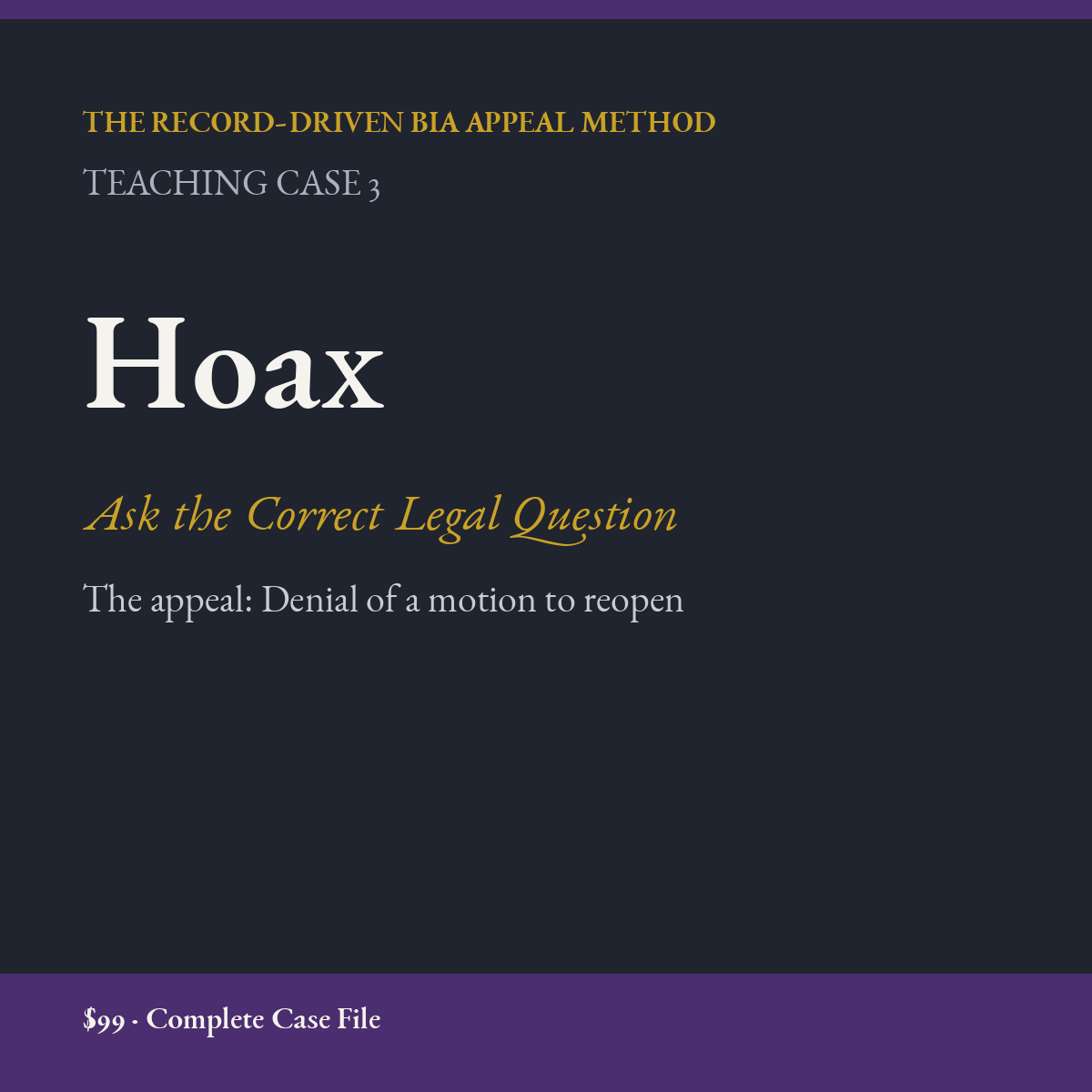
The appeal: Denial of a motion to reopen.
Mental model: Ask the correct legal question before evaluating any answer.
You’ll learn:
✓ Separate the question the law required from the answer the decision gave.
✓ Convert multi-part standards into recited-versus-applied checklists.
✓ Draft remand instructions from the analytical steps the decision omitted.
You’ll benefit most if your appeal involves:
• A reopening denial that reads like a second credibility decision.
• A decision that block-quotes the standard and never applies its parts.
• Evidence the order never mentions, especially evidence with independent legal force.
• A multi-part test where no one can say where each part was decided.
What’s inside:
✓ Teaching Case (the full reconstruction)
✓ Annotated Filed Briefs
✓ Editorial Decisions
✓ Lessons from the case
✓ One-page Cheat Sheet
✓ Teaching Deck
3.Hoax — Teaching Case 3 · $99
The appeal: Denial of a motion to reopen.
Mental model: Ask the correct legal question before evaluating any answer.
You’ll learn
✓ Separate the question the law required from the answer the decision gave.
✓ Convert multi-part standards into recited-versus-applied checklists.
✓ Draft remand instructions from the analytical steps the decision omitted.
You’ll benefit most if your appeal involves
• A reopening denial that reads like a second credibility decision.
• A decision that block-quotes the standard and never applies its parts.
• Evidence the order never mentions — especially evidence with independent legal force.
• A multi-part test where no one can say where each part was decided.
What’s inside: Teaching Case (the full reconstruction) · Annotated Filed Briefs · Editorial Decisions · Lessons from the case · One-page Cheat Sheet · Teaching Deck
The appeal: CAT granted, asylum denied on one record.
Mental model: Accepted findings have consequences.
You’ll learn:
✓ Follow one accepted finding to everything downstream.
✓ Turn a persecutor’s own documents into the nexus argument.
✓ Brief the contradiction no standard of review protects.
You’ll benefit most if your appeal involves
• A decision that grants one form of relief and denies others on the same evidence.
• An accepted document, finding, or concession the decision never follows downstream.
• A persecutor’s own records supplying motive or nexus.
• A written decision that contradicts what the judge said from the bench.
What’s inside:
✓ Teaching Case (the full reconstruction)
✓ Annotated Filed Briefs
✓ Editorial Decisions
✓ Lessons from the case
✓ One-page Cheat Sheet
✓ Teaching Deck
4. Domino — Teaching Case 4 · $99
The appeal: CAT granted, asylum denied on one record.
Mental model: Accepted findings have consequences.
You’ll learn
✓ Follow one accepted finding to everything downstream.
✓ Turn a persecutor’s own documents into the nexus argument.
✓ Brief the contradiction no standard of review protects.
You’ll benefit most if your appeal involves
• A decision that grants one form of relief and denies others on the same evidence.
• An accepted document, finding, or concession the decision never follows downstream.
• A persecutor’s own records supplying motive or nexus.
• A written decision that contradicts what the judge said from the bench.
What’s inside: Teaching Case (the full reconstruction) · Annotated Filed Briefs · Editorial Decisions · Lessons from the case · One-page Cheat Sheet · Teaching Deck
The appeal: DHS appeal of a withholding grant.
Mental model: Read what the other side never challenged.
You’ll learn:
✓ Chart the findings that carry a judgment against the challenges actually made.
✓ Concede strategically and align your brief with the decision under review.
✓ Hold an appellant to clear error, finding by finding.
You’ll benefit most if your appeal involves:
• Defending a grant against a government appeal.
• A partial or divided credibility finding.
• An opponent’s brief that is loud about one issue and silent on the dispositive ones.
• An independent documentary holding the appeal never reaches.
What’s inside:
✓ Teaching Case (the full reconstruction)
✓ Annotated Filed Briefs
✓ Editorial Decisions
✓ Lessons from the case
✓ One-page Cheat Sheet
✓ Teaching Deck
5. Blank Space — Teaching Case 5 · $99
The appeal: DHS appeal of a withholding grant.
Mental model: Read what the other side never challenged.
You’ll learn
✓ Chart the findings that carry a judgment against the challenges actually made.
✓ Concede strategically — and align your brief with the decision under review.
✓ Hold an appellant to clear error, finding by finding.
You’ll benefit most if your appeal involves
• Defending a grant against a government appeal.
• A partial or divided credibility finding.
• An opponent’s brief that is loud about one issue and silent on the dispositive ones.
• An independent documentary holding the appeal never reaches.
What’s inside: Teaching Case (the full reconstruction) · Annotated Filed Briefs · Editorial Decisions · Lessons from the case · One-page Cheat Sheet · Teaching Deck
The appeal: Adverse credibility ignoring independent documents.
Mental model: Demand the missing middle.
You’ll learn:
✓ Quote a decision rung by rung and let the ladder speak.
✓ Name each defect precisely: skipped, unreasoned, wrong-standard, contradictory.
✓ Find the floor — the claim that survives whatever the factfinder thought of the witness.
You’ll benefit most if your appeal involves:
• A decision that states conclusions without connecting them to the record.
• An adverse credibility finding treated as dissolving every claim, including CAT.
• Alternative holdings announced in a sentence apiece.
• Appellate work on a record you did not try, and limited time to master it.
What’s inside:
✓ Teaching Case (the full reconstruction)
✓ Annotated Filed Briefs
✓ Editorial Decisions
✓ Lessons from the case
✓ One-page Cheat Sheet
✓ Teaching Deck
6.Because I Said So — Teaching Case 6 · $99
The appeal: Adverse credibility ignoring independent documents.
Mental model: Demand the missing middle.
You’ll learn
✓ Quote a decision rung by rung and let the ladder speak.
✓ Name each defect precisely: skipped, unreasoned, wrong-standard, contradictory.
✓ Find the floor — the claim that survives whatever the factfinder thought of the witness.
You’ll benefit most if your appeal involves
• A decision that states conclusions without connecting them to the record.
• An adverse credibility finding treated as dissolving every claim, including CAT.
• Alternative holdings announced in a sentence apiece.
• Appellate work on a record you did not try — and limited time to master it.
What’s inside: Teaching Case (the full reconstruction) · Annotated Filed Briefs · Editorial Decisions · Lessons from the case · One-page Cheat Sheet · Teaching Deck